

Sequence in the official description
How the description frames the core loop
Read left to right to move from acquisition to checkpoint progress. The official copy lists these ideas in this order, but it does not state that players must execute them as a rigid sequence.
Five verified concepts form the most useful map of the public game description.
- 1Roll
Obtain fighters through the game’s rolling system; public sources do not disclose exact rates.
- 2Team
Place fighters together as the unit that enters battles.
- 3Merge
Use merging to level fighters, without assuming an unpublished formula.
- 4Waves
Face endless enemies while watching the live battle state.
- 5Checkpoint
Push toward higher checkpoints that the description connects to rewards.
Guide library
Find the next useful page
Move between growth, combat progress, collection evidence, and team decisions without leaving the verified game loop.
Growth system
Merge and level
Separate what the official description confirms from the costs, counts, and formulas it does not publish.
Read moreBattle progress
Waves and checkpoints
Read the visible wave, Team HP, enemy, boss, and checkpoint evidence without turning one screenshot into a universal table.
Read moreCollection goal
Mutations
Compare visually distinct fighter appearances while keeping labels and rarity assumptions outside the evidence boundary.
Read moreTeam basics
Team building
Use role coverage, visible performance, and repeatable observations instead of a fabricated fixed best team.
Read moreRead the arena
The team is the unit that enters battle
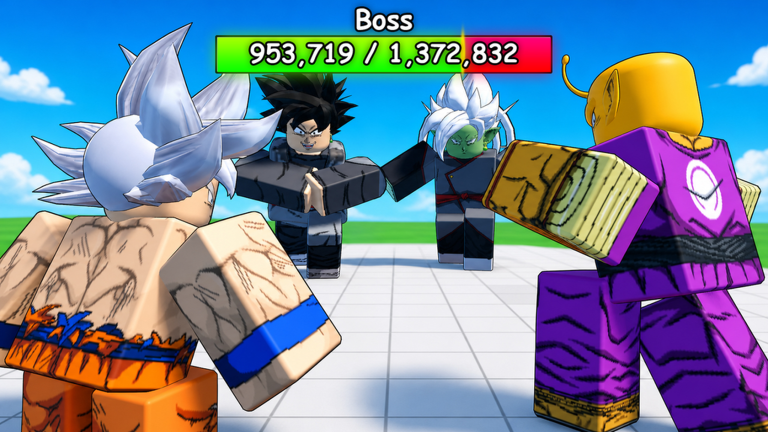
Official arena scenes place several fighters on one side opposite enemies or a boss, while the Team HP display keeps attention on the lineup’s shared battle state.
 Official experience media
 The official images are useful for learning what to watch: multiple allied fighters occupy the battle side, opponents or bosses appear across the arena, and shared combat displays summarize progress. They do not prove a particular roster, a required number of fighters, a damage formula, or a permanent formation rule.
Treat your own live session as the authority for changing details. Compare what happens before and after a roll, merge, mutation, or lineup change, then record only outcomes you can reproduce. That method stays useful even when the live experience updates values that are absent from public APIs.
- Creator
- Another Slop
- Platform
- Roblox
- Server size
- Up to six players, according to first-party game metadata
- Public route boundary
- No complete named roster, rates, merge formula, checkpoint table, codes list, or fixed best team is claimed here
Facts at a glance
Core systems and their evidence limits
The table separates durable first-party statements from details that require live observation.
| System | What public sources support | How to use that information |
|---|---|---|
| Rolling | The official description says players roll fighters. | Use the result screen and your own repeated observations; do not assume a rate that is not published. |
| Team | The official description says players build a team, and media shows several allied fighters in battle. | Compare lineup behavior rather than treating promotional art as a required composition. |
| Merging | The official description connects merging fighters with leveling them. | Confirm eligible inputs and results in the current interface; no public cost or formula is available. |
| Waves | The description says enemy waves are endless, and approved art includes a Wave 67 label. | Use displayed wave and Team HP information as session state, not as a full reward chart. |
| Checkpoints | The description connects higher checkpoints with rewards. | Verify the current reward prompt in-game because public sources do not enumerate every checkpoint. |
| Mutations | The description presents rare fighters and mutations as collection goals. | Use visible appearance and in-game labels; this wiki does not invent a mutation taxonomy. |
Evidence boundary
What this wiki will and will not claim
A small public dataset is a reason to be precise, not a reason to manufacture database depth.
- Published as factOfficial name, creator, Roblox identifiers, six-player server maximum, the description’s named systems, and visual features directly visible in approved media.
- Published as observationA screenshot contains labels such as Level 1/67, Day 1/67, Wave 67, Team HP, boss bars, opposing pads, or a displayed damage number. These stay tied to that frame.
- Left openNamed fighters, complete rarity and mutation categories, rates, merge requirements, full rewards, optimal compositions, current codes, and any inferred cap or formula.
Quick answers
Frequently asked questions
Does the official description prove one mandatory play order?
No. It lists rolling fighters, building a team, merging to level fighters, endless waves, checkpoint rewards, and mutation collecting in a useful editorial sequence. That wording supports an orientation map, but it does not state that every player must perform those actions in exactly that order during every session.
Why does the wiki not list every fighter or roll rate?
The reviewed first-party Roblox listing and APIs do not publish a complete named fighter roster, fighter-stat schema, or roll-rate table. Adding names, percentages, or tiers from unsupported sources would look useful while making the guide unreliable, so the fighter page focuses on visible growth states and repeatable comparison methods.
Are the HP and damage numbers in screenshots universal?
No. Official media contains visible HP, boss-health, and damage numbers, but each number belongs to a particular promotional frame. The images prove that those displays can appear; they do not prove a permanent base value, formula, cap, or result that applies to every fighter and update.
Sources
Last verified: